
Queercoding: Curtailing Censorship or Avoiding Accountability?

Updated: Jan 19
Written by Dylan Lim

Queercoding, the attribution of stereotypically queer attributes to a non-confirmed queer character, is a term that’s risen to prominence in recent times. In some cases, it’s the solution when queerness isn’t seen as socially acceptable or desirable but exists nonetheless. On other occasions, it’s used to give characters complexity without having to commit to confirmation of a controversial subject matter. However, the inherent uncertainty regarding queercoded characters leads to a certain Schrödinger’s-cat situation, where a character cannot be concretely concluded to be queer or not. Creators are able to use this uncertainty in two ways: to curtail censorship or to avoid accountability.
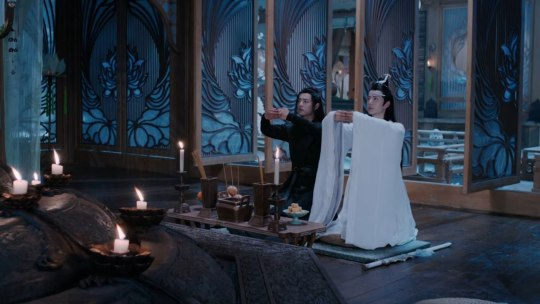
One of the better known instances of queercoding being used to circumvent censorship is The Untamed, a live action adaptation of a danmei, or Chinese boys’ love novel. Due to censorship laws from the China Television Drama Production Industry Association stating that “No television drama shall show abnormal sexual relationships and behaviours, such as incest, same-sex relationships, sexual perversion, sexual assault, sexual abuse, sexual violence, and so on,” it would be logistically impossible to maintain an outright depiction of a queer love story. In spite of this, showrunners were still tasked with creating a faithful adaptation—which is where queercoding came in to circumvent those restrictions.
The characters in The Untamed never outright state they are queer, nor do the two main characters enter a romantic relationship on screen. Despite these limitations, the relationship between the two manages to reveal itself through glimpses of intimacy and subtle symbolism. Deliberate touches and longing glances imply attraction when it cannot be stated outright. The two main characters share three bows in front of an ancestral altar—an old newlyweds tradition—and allow the viewer to draw their own conclusions.
The Legend of Korra, an animated Nickelodeon show, is another notable example of queercoding used explicitly to avoid censorship. The titular main character Korra and her female love interest Asami end the series doing no more than holding hands and locking gazes. There’s no clear confirmation of any romantic relationship between them, but subtext and subtle storytelling hint at something more. Co-creator Bryan Konietzko later confirmed that while Nickelodeon didn’t disallow queer representation, the network also said “there was a limit to how far we could go with it.” Thus, the resulting queercoded scene of the finale—an instance where viewers can pick up on the implication that they are lovers without it being obvious enough to fall under scrutiny.
An unconfirmed example of possible queercoding to avoid censorship appears in Genshin Impact, a popular gacha game created by Chinese company Hoyoverse. Two male characters toe the line between unenthusiastic roommates and bickering boyfriends as they’re depicted as both at odds and affectionate. A pair of female immortals are described simply as “old friends,” yet one spends 500 years awaiting their reunion. But without any direct confirmation from their creators, these characters reside in a gray area where ambiguity reigns.

However, it’s important to recognize the opportunity this ambiguity provides, as it allows for the character’s presumed queerness to be utilized as a marketing tactic. At its core, Genshin Impact is a profit-driven gacha game that monetarily benefits from how attached a player gets to a character, whether it results in pulling for them to play as in-game or purchasing official, branded merchandise. The fact that these characters’ queerness is never confirmed nor denied is unequivocally the most optimal strategy in order to not alienate any possible player demographic. As a result, the company gets to reap the rewards of having a queer character without actually having to stand by the queer community.
This all culminates into a single question: how much of this matters? Does it matter if characters are never confirmed to be queer? Does it matter if queer representation is written with only the intent to make money if it isn’t a harmful depiction? Does it matter if queer audiences see themselves in characters not written to explicitly be queer?
Like most things in life, answers will vary from person to person. There’s ultimately only one question that remains: does it matter to you?


Comments